Sunday, 26 February 2023

Al Di Meola - Casino


I follow Mr. Di Meola of FaceBook, and he recently reminded us that this is the 45th anniversary of the release of the album "Casino". This is a record I have owned for well over 40 years, and it has provided me with many hours of listening pleasure. It has much to recommend it; Al's guitar playing is off the charts, the musicianship of all of the contributors is exemplary, the songs are real songs. and not just a "chops fest" for all concerned (in other words, musical). Mr. Di Meola also  produced and arranged the recoding. The sound is excellent and well balanced. I especially like the way the keyboards are included. Not only are they used for solos, the variety of sounds and textures that they provide are used to enrich the sound of the songs and provide harmonic structure. There is a strong latin (or Spanish) feel to much of the album, and we get to hear some of Al's tasteful classical guitar playing on a few tracks. The term "fusion" can sometimes have negative connotations, and I'm not sure I would classify this record under that genre, but if that is where it belongs, then is an example of that type of jazz as its best.     

Wednesday, 22 February 2023

Wynton Kelly Trio Wes Montgomery "Smokin' in Seattle"


“Smokin’ in Seattle” is the title of a 2017 release on the Resonance label of a pair of live performances featuring the Wynton Kelly Trio with Wes Montgomery. The recordings originated from the Penthouse, a jazz club in (naturally) Seattle. King FM, a local radio station, had an agreement with the club that they could broadcast a weekly radio show featuring live performances from the artists who were booked into the venue. According to the booklet accompanying the CD, the performance was captured using a four channel tube mixer and line amplifier, and four microphones. Jim Wilke, an employee of the radio station, who was the engineer who set up the equipment, indicated that he set the microphones on the stage, placed the mixer and amp on a table next to the stage and attached a telephone line connected back to the studio. He also said “It was a live mix with no EQ, no reverb, no compression and no rehearsal. Over 200 broadcast from the penthouse were aired live this way and simultaneously taped on the studio Ampex, as they were broadcast”. 


These particular shows occurred on April 14th and 26th, 1966. The broadcasts were from the first 30 minutes of each of the two shows. Wynton’s trio opened up, with Wes joining in after a couple of tunes. Wynton’s trio consisted of himself on piano, Jimmy Cobb on drums and Ron McClure on bass. The trio is in excellent form, and provide exemplary support for Wes, who is heard on 6 of the 10 tracks. The band really lets loose and the description in the title of “Smokin,” is no exaggeration when it comes to the music in this release. The sound is also excellent (kudos to the production and mastering crew at Resonance). 

Jazz fans are no doubt overjoyed at being to hear a historic (and high quality) performance from Wes and this trio, (which so perfectly supports him) which heretofore was unavailable. Thanks to Resonance for releasing this amazing gem. I would also add in passing that the CD incudes a very informative 40 page booklet with several interviews, including ones with two surviving band members; Jimmy Cobb and Ron McClure, and great period photos. As I am wont to say, highly recommended.  

Saturday, 5 March 2022

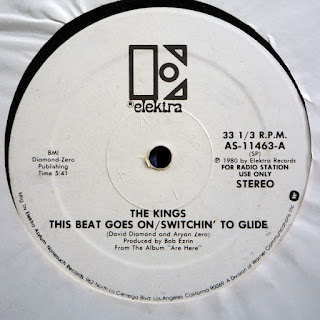
                                     The Kings


                "This Beat Goes On/Switchin' To Glide"


The Kings are a Canadian band that originated from Oakville Ontario during the late 1970’s. The original lineup consisted of Dave Diamond (bass and lead vocals), Mister Zero (guitar), Sonny Keyes (keyboards) and Max Styles (drums). Dave and Max had originally performed together in a band while at high school (which broke up), and then Zero was in another band with Max (which also broke up). Dave and Max graduated to the playing in the local GTA bar scene after high school, while Zero ended up in Vancouver. While there, he met Sonny, and together they began composing. They decided to form a band, returned to Ontario, and Dave and Max were recruited. While the band has the usual suspects as influences (Beatles, Stones, Zep, etc), they were determined to write and perform their own music. One way for a band to get some notice (and airplay) back in those days was for it to enter one of their original songs in a contest held by a local radio station. For The Kings, that meant competing in the first ever home-grown competition sponsored by Toronto powerhouse CHUM FM.  The band had to compete with 600 other entries, but were successful and came in first. According to Zero, “We got a free lunch, and every label turned us down”. 

The band decided to soldier on and record a record on their own as an independent artist. As fate would have it, a chance meeting turned everything around in an instant. The band was working at Nimbus 9, a well known Toronto recording studio at night and during off hours. At the same time, noted Canadian producer Bob Ezrin, fresh from completing Pink Floyd’s “The Wall”, happened to be in Toronto, and decided to stop off at the studio. Zero recalls “Our manager played him our stuff and he liked it.” Bob then agreed to work with the band. Initially, he was just going to remix some of their already recorded tracks, but it was decided to redo everything with Bob at the helm. With his support and assistance, the band then signed with Elektra Records. Bob Ezrin’s involvement was a major turning point in the band’s career. He was a mentor as well as acting as producer. As is now well known, The Kings had a massive hit with the song “This Beat Goes On/Switchin’ To Glide”. Zero explained that originally, they were “two songs that needed something as they weren’t enough on their own. So we thought it might be fun to put them together. That was how Bob heard them but he said something wasn’t right so Dave rewrote the music and Zero redid the lyrics. Add Bob’s incredible production and you have a hit”. 

“This Beat Goes On/Switchin’ To Glide” was a staple on the radio during the summer of 1980. The song was a hit right across North America, with heavy airplay here in Southern Ontario. There were a number of musical aspects to the song that contributed to its success. The muscular guitar riff to start the song, the dance-floor friendly tempo and the 1960’s influenced keyboard sound instantly grab the listener’s attention. The band’s look and the song structure were a perfect for the nascent New Wave music scene in North America. The transition from “This Beat Goes On” to “Switchin’ To Glide” is a highlight of the song, with a band-shouted chorus leading to different series of chords, followed by the keyboardist playing a descending single tone (I believe using a “Mini-Moog” synthesizer) to introduce the next segment of the song. It should be noted that the song’s tempo never shifts. The song enjoyed a lengthy stay of 23 weeks on Billboard’s Hot 100. (Here is a link to short video about the song courtesy of Behind The Vinyl Boom 97.3 https://www.boom973.com/2016/10/11/behind-the-vinyl-this-beat-goes-on-switchin-to-glide-the-kings/With the success of their hit single, The Kings found themselves on the concert circuit opening for some the bigger acts of the day, and were invited to perform on American Bandstand. They also obtained a coveted spot on the bill for the famous Heatwave Festival, which was noteworthy for its emphasis on featuring New Wave and Punk artists. As Zero related to me “Heatwave promoter John Brower was a guy we met around town and he thought we were good enough to be on the bill. We played last because we wanted to be under the lights at night. We’re so glad we have the movie of that night; it shows us at a specific moment and time, rocking out” (The Kings portion of the concert was filmed). With their hit single, The Kings enjoyed great sales and radio play both here in Canada and south of the border. They continued to record, but were not able to duplicate the success they had with "This Beat Goes On/Switchin' To Glide".  There are a few versions of the song; it was included on the band's debut album "The Kings Are Here" and of course was released as a single. The Kings certainly hit it out of the park with this song, and it deservedly has established itself as a Canadian summer classic. The Kings are still active, and of course have their own website if you would like to know more about the band.  


Friday, 17 December 2021

Malcolm Burn Walk Don't Run


Malcolm Burn has had a very successful career as a producer, working over the years with many artists, including Emmylou Harris (he produced her Red Dirt Girl album, which won in the Best Contemporary Folk category at the 2001 Grammys), Daniel Lanois and Iggy Pop. Prior to his career as a producer, he was active as a songwriter and musician. Hailing originally from Deep River Ontario, Malcolm moved to Toronto and in 1981 was a member of the New Wave band Boys Brigade, and was one the band's vocalists as well as playing keyboards and being a songwriter. The group was part of the Queen Street West music scene, and in 1983 released a top 40 single, "Melody" that Malcolm had helped to write. Besides receiving extensive airplay, the song's video featured prominently on the Canadian music video show, Much Music.
Before he commenced on his music production career though, in 1988 he released a solo album titled "Redemption". While the album may not necessarily have been a big seller, it has its devoted fans. In particular, the single from the album, "Walk Don't Run" stands out as a classic slice of late 1980's post new wave guitar driven rock. 
I recently spoke with John Whynot about the album. John, a successful Canadian musician, composer and producer in his own right, was very generous with his time and reminisced about the project. Concerning its genesis, (and his involvement), he said that he was hanging out with Malcolm quite a bit at the time, and they just decided to go into the studio to work on some songs that Malcolm had. I asked John about the musicians on the project. John didn't think Malcolm had an actual band at the time, although of course there a few people around he had been playing with. John asked his friend Glenn Milchem to play drums on the project, and Andy Curran played bass. (Glenn is best known as the drummer for Blue Rodeo and Andy was the original bassist and singer with Coney Hatch). John recalled that Malcolm was friends with guitarist Bill Dillon who also contributed. (And on a side note, please take a moment to check out Bill's career, it's incredible!). Basically, "it was kind of pick up, but each participant was fantastic". When it came to the actual recording of the music, John advised me that he and Malcolm "had a kind of relationship with the people who had inherited or bought Grant Avenue studio from the Lanois brothers, and so we went out to Hamilton to do some of the recording. Dan Lanois also got involved along the way, and he ended up remixing some of the songs we did, along with Malcolm. Right after all this, Malcolm went off to New Orleans to work with Dan on some other projects (some band called The Neville Brothers and some guy named Bob Dylan). I went to LA shortly after, too, so we weren't hanging out so much anymore. Still pretty good friends, though." 
The single from the album that most people will remember was "Walk Don't Run" (there were two versions, a 7" and also a 12"). This was the song that got some airplay (I specifically remember hearing it on CFNY, with Malcolm actually speaking over the intro introducing himself). It is a pretty straight forward rocker, with a catchy chorus and a great finish (or "outro" as some might put it). As one might anticipate, with Daniel Lanois involved, the song is very well recorded and mixed. 
To call Redemption a cult classic or forgotten masterpiece would be over egging the pudding. It is though an example of a good songwriter preparing, recording and producing a fine batch of songs, and to be fair, certainly has its devoted fans. The album is available for download from Apple Music (or you can just listen to it on YouTube) Also readily available for your viewing pleasure is the video made to promote the single Walk Don't Run (which John emphatically advised he was not in). The album was released on the Anthem label here in Canada.  


Wednesday, 16 June 2021

Bob Carpenter & Silent Passage


Guitarist Bob Carpenter was a Canadian singer and songwriter who performed in the folk genre during the early 1970’s, a period generally considered the golden age of Canadian music. Although not well known (even during his performing years), he was well respected by his peers, with artists such as Emmylou Harris and Billy Joe Shaver recording his songs. He is generally associated with the West Coast, although he was born and grew up in the North Bay area of Ontario. I was unable to uncover much about Bob’s early years, although apparently he started out like many other “folkies” in the Yorkville era of the mid ’60’s. He somewhat mysteriously appeared at the farewell party for the artists who were part of the Festival Express, a legendary series of 1970 Canadian concerts featuring Janis Joplin, The Grateful Dead, The Band, The Flying Burrito Brothers and Ian and Sylvia’s Great Speckled Bird among others. The party was held at the York Hotel in Calgary, and his performance was impressive enough to merit special recognition by the reporter from Rolling Stone who was covering the Festival Express tour. 

Bob continued to hone his craft, mainly in Canada it would seem, in the following years. He was getting noticed however, and a contract with Warner Brothers in 1974 led to recording sessions in Los Angeles with noted Canadian producer Brian Ahern. The result was the cult classic “Silent Passage”. The making of the record, it would seem, was fairly straight forward. Brian had assembled a first rate band to support Bob; session musicians extraordinaire Lee Sklar on bass and Russ Kunkel on drums, Bill Payne and Lowell George from Little Feat of piano and slide guitar respectively, pedal steel ace Buddy Cage and Emmylou Harris and Anne Murray (yes, our Anne Murray) on background vocals. On listening to the music, it seems one could not have found a more sympathetic musical partner than Brian Ahern. The production is not lush, but the instrumentation provides support and context to Bob’s sparse guitar and vocals. His voice has to be heard; the gentle intensity and sincerity is stunning. Comparisons do not come easily, perhaps one can detect a hint of Harry Chapin here and some Bob Dylan there, but really, Bob was his own man, and these are his songs. Although all of the tracks are outstanding, the title song simply knocks it out of the park. Bob was not at all a technical singer, but the songs were written to provide a vehicle for the story he wanted to tell, and his ability through his voice to tell that story was his strength. I learned of this record through Lee Sklar’s youtube channel, where he talks about the recording sessions he has been involved in. Interestingly, Lee recalls that on projects like this nothing was written out. He and some of the other musicians simply came into the studio and listened to the artist perform his songs, and then tried to come up with a part that fit. Having the quality of this type of musicianship is integral in ensuring the artist’s vision of their music is maintained, and having a sympathetic producer doesn’t hurt either. 

Creating a masterpiece is one thing, getting it to the public so they can listen is unfortunately another. For whatever reason, the label decided against releasing the record. After listening to the finished product it seems stunning that the whole thing was shelved. I haven’t been able to find any specific reason, maybe there wasn’t one. Record companies are notoriously fickle and arbitrary. Sadly that might have been the end of it, but Bob had supporters and in 1984 Holger Petersen’s Canadian label Stony Plain Records acquired the rights to the album and it finally saw the light of day (or so the story goes, details to follow). The album has continued  to be in demand, with glowing reviews from publications such as Rolling Stone, including in 2014 when the magazine selected Silent Passage as one of the top 10 reissues of the year.  

For those that want to hear the record, it is available digitally. For vinyl purists, it gets a little murkier. When one ventures on-line to conduct a search, vinyl copies of the record on the Reprise label appear. So how is it that a record that was apparently never released in 1975 be found for sale in 2021? While I don’t have a definitive answer, it would appear that some number were pressed before the decision was made not to officially release the record. After that, a third party could have bought them (who knows why) and surreptitiously put them our for sale. I’m not sure how they could otherwise have got out there. Vinyl copies (at a much more reasonable, although still steep price) from Stony Plain can also be found for sale on-line. Interestingly, Stony Plain also used the same cover art (front and back) as the original version. There is also the 2014 compact disc reissue from No Quarter, and of course, iTunes. 

Bob Carpenter was a very spiritual person, and it seems in the years after the recording of Silent Passage, he decided to move on from the music business to pursue a more religious life. He died quite tragically and far too early to cancer when he was only 50. I am very recent convert, and so I admit I may lack objectivity, but the recording really is extraordinary and his music deserves recognition. As I like to say, highly recommended.  

Saturday, 1 May 2021

                                                                    Blue Peter


"Don't Walk Past"


With the recent tragic and untimely passing of Blue Peter lead singer and frontman Paul Humphrey, the timing is right for a review of their iconic single, “Don’t Walk Past”. Both the song and its accompanying video were ubiquitous during the summer of 1983 here in Southern Ontario. The song itself was a classic in the New Wave genre featuring soaring vocals and synthesizer; one of those tunes that once heard is instantly recalled by the listener. 

Hailing from Markham Ontario, the band started during the later part of the 1970’s when high school chums and band co-founders Paul Humphrey (lead vocals) and Chris Wardman (guitarist and songwriter) began practising and writing songs in Wardman’s basement. According to the biography section from the band’s excellent website (bluepeterband.com), during this period as the band began take shape and play out, “Humphrey remembers that the era was one in which many new bands faced certain challenges that made the going difficult. "In those early days, there were no places for a band who did original material to play. In a lot of bars, you had to play cover tunes, so we came up with our own treatments of the Stones, Iggy Pop, Led Zep, and the like, but we really wanted to have a way of exposing our songs. Besides," Paul continues, "we really couldn't play a lot of those covers 'cause we found it just didn't work that well with our energy." Times did change, however, and the live venue scene in Toronto started to open up, providing more opportunities for young, up-and-coming bands to get a shot at playing gigs. "It was an exciting time," recalls Humphrey. "Clubs like The Edge and Larry's Hideaway opened up and a lot of good bands with original music got a chance. There's a certain musical historical element to those days, and we were part of it." 

The first several years of the band (1979 -1983) were spent in sorting out personnel and honing the group’s identity. Their trajectory was not meteoric, but it was a steady progression of recording and performing. Blue Peter were a popular draw on the local club scene, with their visibility being boosted when they were selected to open for British New Wave acts that were touring here in Ontario. During this time period, the unique sound they were developing was being recognized locally with support from independent FM radio station CFNY and the weekly music and cultural television newsmagazine “The NewMusic”. Having your songs played on the radio is crucial in generating record sales, and prior to the release of “Don’t Walk Past”, the band had recorded and released a few singles, a couple of EP’s and a full fledged album, “Radio Silence”. In 1983, the band recruited English music producer Steve Nye, whose credits included work with Japan and Bryan Ferry, to work on their new material. Out of those sessions they released what is generally considered their signature song, “Don’t Walk Past”.  

The version of the band that recorded “Don’t Walk Past” consisted of mainstay’s Humphrey and Wardman, as well as Rick Joudrey (bass), Jason Sniderman (keyboards), and Owen Tennyson (drums). The single was released on the Canadian label Ready Records in both seven inch (catalogue number SR 331) and a twelve inch (catalogue number SRB 033) versions. It was also part of their album Falling. The accompanying video of the song has been recognized as one of the top Canadian music videos of its time, winning the “Best Video of 1983” award from the Canadian Film and Television Association. In addition to Paul Humphrey's passionate vocals, the song had a strong groove, with keyboards providing most of the melodic structure, a simple but punchy bass line and minimal but effective guitar. It is easy to see why the song and its accompanying video have had such an impact on the Canadian music scene. For better or worse, in the age of music videos, appearances became crucial in breaking a band and getting their videos played. Besides Paul Humphrey’s talents as a vocalist, he was very telegenic. As well as being aired in Canada, the video was picked up by MTV and broadcast in the United States. It should be noted that with his untimely passing, several Canadian artists who were part of that scene, (or were up and coming), have acknowledged the influence of the band and Paul in particular. Gord Deppe of Spoons fame stated that “Paul was one of the kindest and most talented people I ever met”.

Although “Don’t Walk Past” was crucial in increasing its popularity, the band would call it quits in 1985. They will always be closely identified with the song though, and its success cemented Blue Peter’s importance as part of the Canadian New Wave music scene.

Sunday, 21 March 2021

FM - Phasors On Stun


“FM” was the name of a band formed in Toronto in 1976. The first version was duo featuring Cameron Hawkins (keyboards, bass guitar and vocals) and Jeff Plewman (violin, mandolin, vocals), better known by his stage name “Nash the Slash”. Although Nash the Slash would later become better known for his stage persona which featured him having his face completely covered in wrapped bandages, sunglasses, top hat and tuxedo, at this point he was just wearing the sunglasses, tux and top hat. From the start the band performed their own original compositions. On of their first public appearances would be on the Ontario public broadcaster TVOntario (better known through its acronym “TVO”) as featured artists in the network’s Nightmusic concert series. This specific performance is currently available for viewing on-line for those who may be interested. The band had a unique sound, featuring layered keyboard textures and creative synthesizer melodies from Cameron Hawkins alongside Nash’s ethereal violin and mandolin playing. Both band members also sang. An early version of one the band’s best known songs, “Phasors On Stun”, was performed at this time.


In early 1977 Martin Deller (drums) joined the group making it a trio. His addition provided a propulsive drive that cemented the band’s sound. It was this lineup that was invited to appear the CBC television variety show “Who’s New”, resulting in the CBC offering to pay the band for an album length recording session. It was out of this process that the band’s first album was created. Included in this process was the release of a promotional single, “Phasors On Stun”. The album, “Black Noise”, was released by the CBC, although it was only available in limited quantities, and in 1978 was re-released on the GRT/Passport label domestically (and was readily available for purchase). Black Noise became a good seller, with the single Phasors On Stun a staple on FM radio. The album has stood the test of time quite well, being ranked as number 48 by Rolling Stone magazine as one of their top 50 in the category of progressive rock. I would not describe the album as being overtly “spacey”, although it does have a futuristic feeling with an overtone of science-fiction, and for a prog rock album, is quite accessible.  


As a 7 inch single, Phasors On Stun was released in two different versions. The promotional version featured a stereo version on one side, and a mono version of the other. The version that came from the GRT/Passport release of Black Noise was a later take, and featured another song from the album as the B side. The first version was about 30 seconds shorter than the later release. The later version would be the one most closely identified with the group. The song starts with a series of keyboard and mandolin figures, joined by the drums before the first verse is sung. The actual words Phasors On Stun never appear in the song, although a sound effect meant to simulate the discharge of a phasor (the science fiction version of a handgun from the 1960’s Star Trek television show) can be heard in the background during the final verse. The song has a push/pull feel from the bass line and the vocal phrasing, and like any good single, instantly imprints itself on the listener. As I have indicated earlier, it was a popular song on rock FM radio throughout Southern Ontario, and was the song that would be most closely associated with the group. Shortly after the album’s release, Nash the Slash decided to leave the group, and was replaced by Ben Mink. This trio was the one that I recall seeing in the Toronto club scene in the early 1980’s. 


FM would continue to perform, albeit with a number of personal changes. Cam Hawkins has been the consistent member throughout the various versions of the band. Nash The Slash would also perform as a solo act. To “dial in” a classic song from one of Canada’s 1970’s most accessible progressive rock groups, tune in your radio to FM, and enjoy Phasors On Stun.